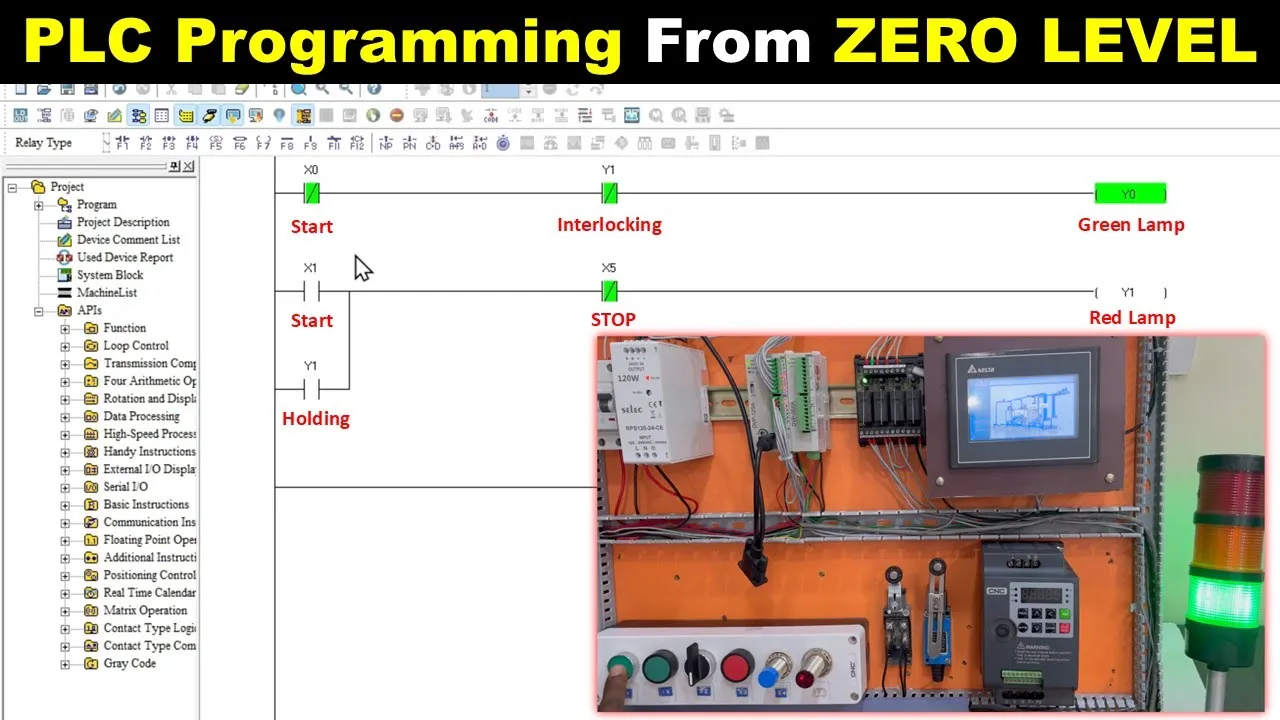
Laying the Foundation: Decoding PLC Programming from Zero
In the dynamic world of industrial automation, the Programmable Logic Controller (PLC) stands as the indispensable brain, orchestrating complex processes with precision and reliability. For anyone looking to enter or advance within this field, a robust understanding of PLC programming is not just beneficial, but essential. We recently explored a foundational video titled "PLC Programming Class from Zero Level | Start PLC Step by Step" by @ElectricalTechnician, which promises a clear and practical introduction to this critical discipline.
Key Takeaways
- Gateway to Automation: This class serves as an ideal entry point for absolute beginners with no prior PLC knowledge, demystifying the core concepts of industrial automation.
- Comprehensive Beginner's Curriculum: It covers the fundamental operational principles of PLCs, basic concepts, and crucially, cultivates the logical thinking essential for effective program development.
- Broad Audience Appeal: Tailored for electricians transitioning to automation, ITI, diploma, and engineering students, freshers, and experienced professionals seeking to upskill in industrial controls.
- Practical and Accessible: The methodology emphasizes a step-by-step, practical approach, making complex topics digestible and relatable for real-world application.
- Strong Foundational Building: The video aims to equip learners with a solid base, preparing them for more advanced topics in PLC and HMI programming and broader industrial applications.
Technical Analysis
The "zero level" approach to PLC programming necessitates a careful breakdown of core engineering principles before delving into specific programming languages or hardware. While the video doesn't provide a transcript, the description strongly implies a focus on these foundational elements:
-
Understanding PLC Architecture and Operation:
A crucial starting point is grasping what a PLC is and its role. This involves understanding its fundamental components: the Central Processing Unit (CPU) for executing logic, Input/Output (I/O) modules for interfacing with real-world sensors and actuators, memory for program and data storage, and the power supply. The concept of the PLC scan cycle—where the PLC reads inputs, executes the program, and updates outputs sequentially—is paramount to understanding its deterministic behavior. This cycle ensures predictable operation, a cornerstone of industrial control system reliability.
-
Basic PLC Concepts and Ladder Logic Introduction:
For beginners, the introduction typically revolves around Ladder Diagram (LD) programming, given its graphical resemblance to traditional relay logic circuits. This section would logically cover:
- Inputs and Outputs: Differentiating between discrete (on/off) and analog (continuous value) signals and how they are represented within the PLC. Examples include pushbuttons, limit switches, proximity sensors as inputs, and motor contactors, solenoid valves, and indicator lights as outputs.
- Boolean Logic: Translating real-world control requirements into logical operations like AND, OR, NOT, and their implementation using ladder logic contacts (Normally Open - NO, Normally Closed - NC) and coils (Output Energize - OTE).
- Basic Instructions: Familiarity with fundamental instructions like XIC (Examine If Closed), XIO (Examine If Open), and OTE (Output Energize) is essential for constructing simple control routines.
- Memory Bits: Understanding internal flags or memory bits that act as internal relays, allowing for complex logic without physical outputs.
-
Developing Logical Thinking for Programming:
Beyond syntax, the most critical skill for a PLC programmer is the ability to translate a desired process flow into a logical, executable program. This involves:
- Problem Decomposition: Breaking down a complex industrial process into smaller, manageable control tasks.
- Sequential Control: Implementing step-by-step operations, such as a motor start-stop sequence, ensuring proper interlocking and safety.
- Interlocking and Safety: Understanding how to prevent undesirable states (e.g., forward and reverse motor operation simultaneously) and integrating emergency stop logic.
- State-Based Logic: Designing programs that respond correctly to different operational states of a machine or process.
This foundational understanding is crucial for any aspiring automation engineer, as it directly underpins the control of motors, pneumatic and hydraulic systems, conveyor belts, and a myriad of other industrial machinery. Mastering these basics is the prerequisite for moving on to advanced topics like HMI integration, PID control, and industrial networking protocols.
Conclusion
The journey into industrial automation, with its promise of enhanced efficiency and control, begins with a solid educational foundation. The "PLC Programming Class from Zero Level" video by @ElectricalTechnician appears to be an excellent starting point for anyone eager to grasp the fundamentals of Programmable Logic Controllers. By demystifying how PLCs work, introducing core concepts, and fostering essential logical thinking, it provides the bedrock upon which successful automation careers are built. For electricians transitioning to the digital realm, students exploring their career paths, or seasoned professionals seeking to expand their skill sets, this introductory class offers a practical and accessible pathway into the heart of modern industrial control systems. Embracing these foundational principles is the first step towards becoming a proficient and impactful engineering professional in the realm of Motors, PLC, and Automation.
Watch the full video here: https://www.youtube.com/watch?v=HMLpVNrAXms


