The electric vehicle (EV) market is a crucible of innovation, often muddled by marketing hyperbole. For years, the promise of "solid-state batteries" has captivated engineers and consumers alike, frequently delivering incremental advancements under revolutionary labels. But a seismic shift is underway, originating from China, poised to redefine the very meaning of a solid-state battery. The Chinese Ministry of Industry and Information Technology (MIIT) has just unleashed a game-changer: a stringent 2026 law banning "semi-solid" batteries from bearing the coveted "solid-state" label, effectively exposing major players and validating long-held suspicions about the "Solid State Battery Lie."
While some brands leveraged gel-based solutions as a technological marvel, one company quietly engineered a genuine breakthrough. Join us as we dissect the raw engineering behind SAIC Motor's new Sulfide-based solid-state battery, now entering production, and critically compare it to market leaders like BYD's Blade Battery. This isn't just about new tech; it's about exposing the truth and understanding the real physics problems solved.
Key Takeaways
- The Regulatory Hammer: A new 0.5% liquid content law by MIIT will disqualify "semi-solid" batteries from being marketed as true solid-state by 2026, marking a clear distinction between genuine innovation and marketing ploys.
- Density Dominance: SAIC’s new Sulfide-based battery achieves an impressive 400 Wh/kg, effectively doubling the energy density of current market leaders like BYD’s Blade Battery (approx. 150 Wh/kg).
- Cost-Cutting Innovation: SAIC employs a "Dry Electrode Coating" process, eliminating the energy-intensive drying ovens and significantly reducing manufacturing costs—a valuable lesson for the entire industry, including Tesla.
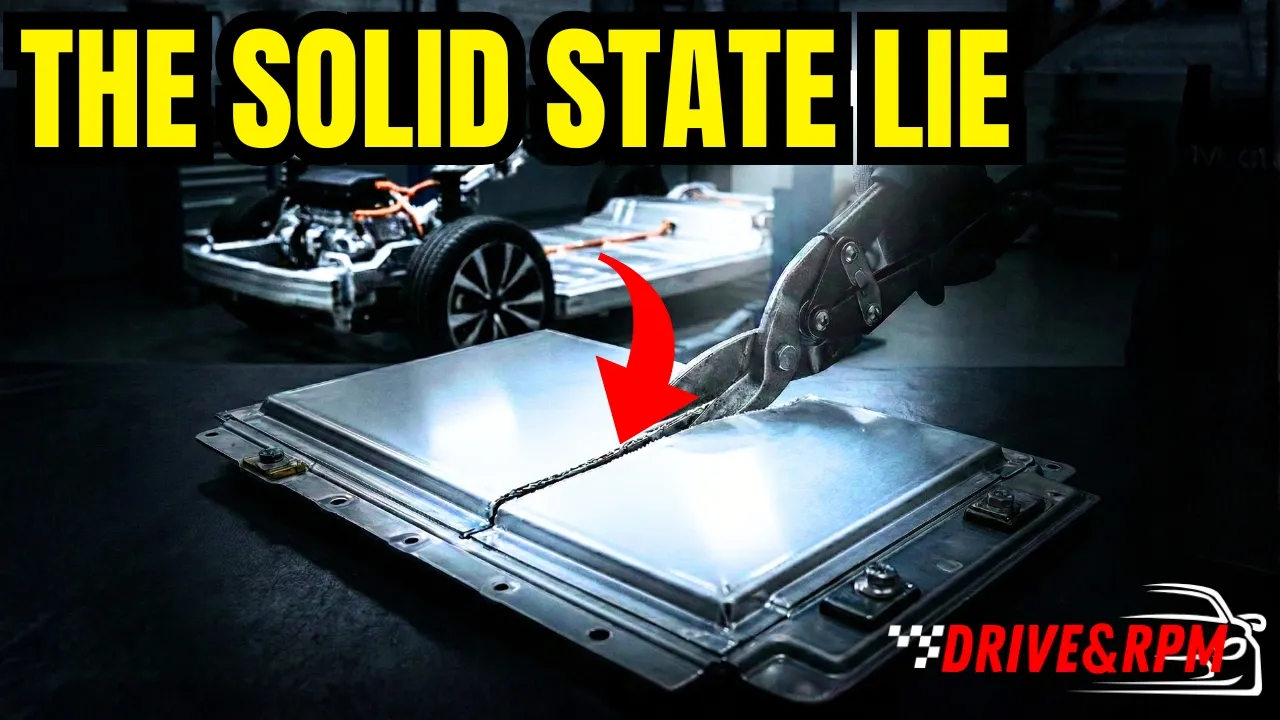
- Unparalleled Safety: True solid-state batteries demonstrate exceptional safety, as evidenced by a "Death Test" where the battery can be physically cut without thermal runaway or explosion, a stark contrast to conventional lithium-ion cells.
Technical Analysis
The EV battery landscape is fundamentally changing, driven by both regulatory clarity and genuine engineering breakthroughs. For too long, the term "solid-state battery" has been loosely applied, causing confusion and inflated expectations. Companies like NIO, for instance, have marketed batteries with significant gel or liquid electrolyte content as "solid-state," pushing the boundaries of definition and consumer understanding.
The MIIT's 2026 Mandate: No More "Semi-Solid" Marketing
China's MIIT has intervened decisively. Their new regulation, effective 2026, stipulates that for a battery to be labeled "solid-state," its liquid electrolyte content must be less than 0.5% by weight. This seemingly small percentage has massive implications, as it instantly reclassifies many existing "solid-state" or "semi-solid" offerings as simply advanced lithium-ion batteries. This move brings much-needed honesty to the market, forcing companies to genuinely innovate rather than simply repackage existing technology with misleading labels.
SAIC vs. BYD: A New Benchmark in Energy Density
While much of the industry was preoccupied with incremental gains, SAIC Motor has been diligently working on a true solid-state solution using sulfide-based electrolytes. The results are astounding. SAIC's new battery boasts an energy density of approximately 400 Wh/kg. To put this into perspective, BYD’s highly regarded Blade Battery, a marvel of pack-level efficiency and safety for traditional LFP chemistry, typically achieves around 150 Wh/kg. This difference is not just an improvement; it’s a generational leap, promising significantly longer ranges for EVs without increasing battery size or weight.
SAIC's sulfide-based chemistry represents a fundamental shift away from the inherent challenges associated with liquid electrolytes, such as flammability and dendrite formation. By solving the core physics problem of ion conductivity in a truly solid medium, SAIC has unlocked superior performance and safety metrics, setting a new bar for the industry.
The Dry Electrode Coating Process: An Engineering Masterstroke
Beyond chemistry, SAIC is also innovating in manufacturing processes. Their adoption of a Dry Electrode Coating process is a game-changer for cost and environmental impact. Traditional battery manufacturing relies heavily on wet slurry processes, which involve dissolving active materials in solvents, coating electrodes, and then drying them in massive, energy-intensive ovens. This drying step alone can account for a significant portion of the battery's manufacturing cost and carbon footprint.
By eliminating the need for these enormous drying ovens, SAIC drastically cuts down on energy consumption, equipment footprint, and manufacturing complexity. This method not only reduces production costs but also accelerates the manufacturing process, making true solid-state batteries more economically viable for mass production. It's a testament to smart engineering that addresses both performance and economic viability, offering a critical lesson to all battery manufacturers, including those like Tesla who are also actively exploring dry coating technologies.
The Death Test: Unpacking True Solid-State Safety
One of the most compelling demonstrations of SAIC's true solid-state battery is what we call the "Death Test." In this harrowing experiment, a fully charged solid-state battery is physically cut with scissors. Unlike conventional lithium-ion batteries, which would typically short circuit, overheat, and potentially explode due to thermal runaway, the SAIC battery remains stable. There’s no fire, no smoke, and no violent reaction.
This remarkable safety profile is inherent to the truly solid electrolyte, which is non-flammable and provides a robust physical barrier against dendrite penetration and internal short circuits. This breakthrough not only significantly enhances occupant safety in EVs but also simplifies the complex thermal management systems required for current liquid-electrolyte batteries, potentially leading to further weight and cost reductions in vehicle design.
Conclusion
The EV battery market stands at a critical juncture. The Chinese MIIT's new regulation is not just a bureaucratic formality; it's a declaration of truth, forcing the industry to distinguish between genuine engineering breakthroughs and marketing spin. SAIC Motor, with its new sulfide-based solid-state battery and innovative dry electrode coating process, is at the forefront of this new era. By delivering double the energy density of current market leaders like BYD and demonstrating unparalleled inherent safety, SAIC isn't just building better batteries—they're setting a new global standard for electric mobility.
This isn't merely an incremental upgrade; it’s a fundamental shift that promises longer ranges, safer vehicles, and more sustainable manufacturing. For those of us who appreciate pure mechanics, raw engineering analysis, and the unvarnished truth about EV technology, this development is a powerful wake-up call and a crucial glimpse into the true future of electric mobility. The "Solid State Battery Lie" is over; the era of real solid-state is finally here.
Watch full video: https://www.youtube.com/watch?v=jZdzJhH7Lu0


